
Siding Repair or Replacement? How to Tell What Your Ontario Home Needs
A practical guide to deciding when isolated siding damage can be repaired, when one wall may need replacement, and when the problem may be bigger than the panels you can see.
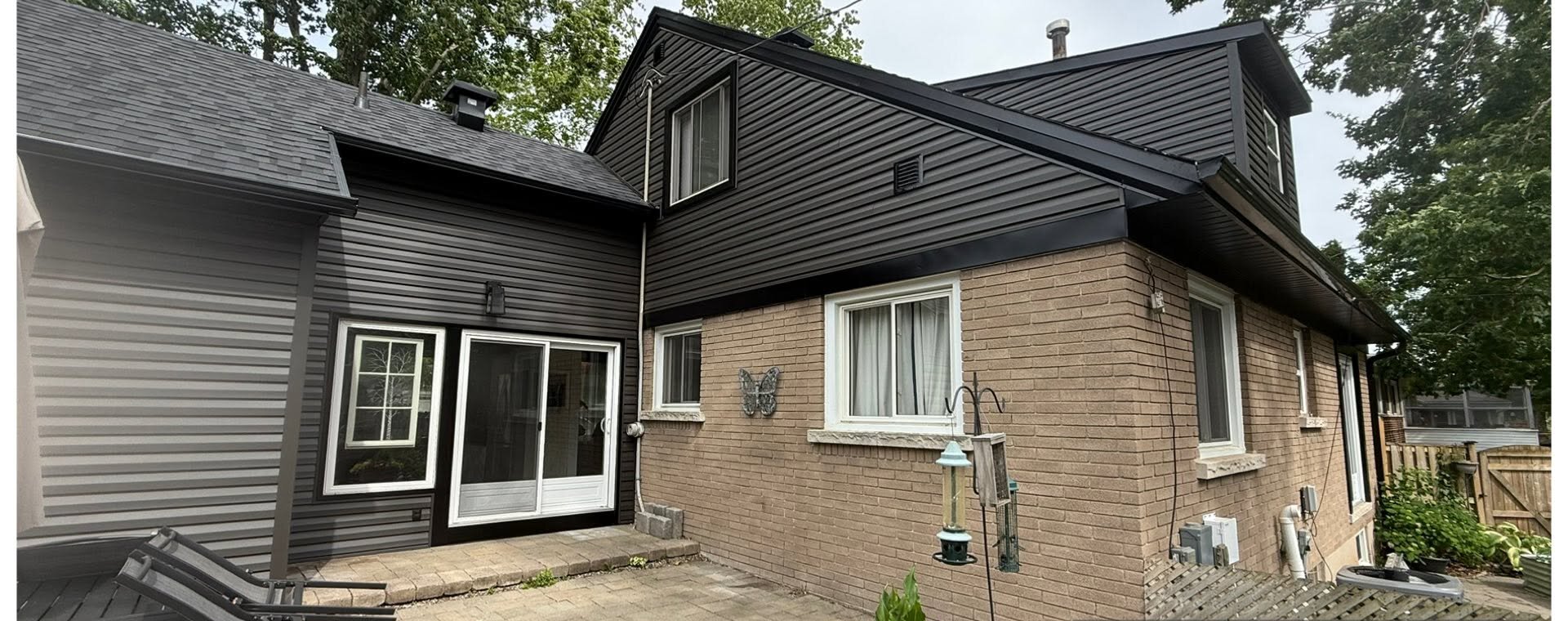
A cracked siding panel does not automatically mean your whole home needs new siding. But patching the visible damage can also be the wrong answer if the panel failed because it was fastened too tightly, the wall is getting wet, or the material has become brittle across a larger area.
This guide will help you sort visible siding problems into four practical paths: a targeted repair, partial replacement, full replacement, or further investigation before anyone decides what the work should include.

The quick answer
- Repair usually makes sense when the damage is isolated, the surrounding siding is still sound, the wall behind it appears dry, and compatible material can be found.
- Partial replacement usually makes sense when one wall, gable, elevation, or detail zone has failed but the rest of the home is performing properly.
- Full replacement becomes more practical when failures are widespread, recurring, brittle, badly mismatched, or connected to broader installation and moisture problems.
- Investigate before deciding when there is staining, softness, musty odour, interior paint damage, repeated leakage, or any reason to suspect the wall behind the siding is wet.
Siding is more than the visible skin of the house
Siding helps shed rain and snow, shields the wall from ultraviolet exposure and routine weathering, and gives the home a durable exterior finish. It is also only one part of the wall.
Canadian building guidance treats exterior cladding as the first layer that handles precipitation. Behind it, house wrap or another water-resistive layer, along with properly integrated flashing, should collect incidental water and direct it back outside. In some assemblies, a drainage and ventilation space also helps the wall dry.12
That distinction matters because a siding problem may actually begin somewhere beside or behind the panel:
- missing or failed flashing above a window or door
- water entering where a roof meets a wall
- poorly detailed vents, lights, pipes, or hose connections
- siding installed too close to soil, mulch, decks, patios, or roofing
- overflowing eavestroughs or downspouts discharging beside the wall
- damaged sheathing, house wrap, trim, soffit, or fascia
New siding alone does not repair hidden rot, correct bad grading, replace missing flashing, stop every air leak, or guarantee lower energy bills. Those improvements require the related wall and drainage work to be included in the scope.
When a targeted siding repair is usually reasonable
A repair is often the sensible first option when the problem is truly local and the surrounding system is still working.
Common examples include:
- one or two cracked vinyl panels
- a single loose or missing panel after wind
- an isolated dent in aluminum siding
- a damaged corner post or trim piece
- localized impact damage around a vent or fixture
- one failed seam or small area of sealant failure
- a short section damaged by a ladder, branch, lawn equipment, or vehicle
The visible defect is only half the decision. Before repairing it, the contractor should still ask why it failed.
A vinyl panel that cracked after a direct impact may only need replacement. A row of panels that repeatedly buckles in warm weather may point to fasteners driven too tightly or missing expansion clearance. A loose panel after one severe wind event may be local damage; repeated blow-offs on the same elevation suggest the fastening, starter strip, locks, or substrate need a broader review.3
Material matching is another practical limit. Older siding may have faded, and the original colour, profile, thickness, or locking system may no longer be available. The repair may work mechanically but remain visible. That is not automatically a reason to replace the whole home, but it should be discussed before the work begins.
When partial replacement may be the better middle ground
The decision is not always “replace one panel” or “replace the entire house.” Replacing one complete wall, gable, elevation, or detail zone can be the most practical option.
Partial replacement often makes sense when:
- hail or wind damaged one exposed side of the home
- one south- or west-facing wall has aged much faster in the sun
- several openings on one elevation share the same trim or flashing problem
- a renovation or addition creates a natural transition between old and new work
- one wall has localized moisture damage but the other elevations remain sound
- the existing profile cannot be matched closely enough for a small invisible patch
- repeated repairs are concentrated in one defined area
The transition between old and new work must still be handled as part of the wall system. House wrap, flashing, trim, drainage paths, and expansion space should remain continuous. A clean-looking edge is not enough if water can get behind it.
Partial replacement also requires an honest conversation about appearance. New material can differ from weathered siding in colour and gloss, even when the product name appears to match. Sometimes replacing a complete wall gives a cleaner result than scattering noticeably different panels across the elevation.4
When full siding replacement becomes more practical
Full replacement is usually justified by a pattern, not a single blemish.
Warning signs include:
- widespread cracking, buckling, warping, or loose panels
- vinyl that has become brittle and breaks while nearby pieces are removed
- recurring wind damage across several elevations
- broad aluminum denting, punctures, corrosion, or finish breakdown
- repeated repairs around several windows, doors, or penetrations
- widespread staining, softness, rot, or deteriorated sheathing
- systemic flashing, clearance, fastening, or drainage defects
- siding that cannot be repaired without damaging large areas around it
- discontinued materials that make every repair visibly inconsistent
- a major exterior retrofit that already requires the wall to be opened
Faded siding is not necessarily failed siding. A home can look dated while the wall still performs properly. The replacement case becomes stronger when appearance problems are combined with brittleness, recurring failures, installation defects, or evidence that the wall behind the cladding needs work.
Repair, partial replacement, full replacement—or investigate first?
| What you are seeing | Most likely path | What must be checked before deciding |
|---|---|---|
| One cracked or impact-damaged panel | Targeted repair | Adjacent locks, fasteners, flexibility, and whether the material can be matched |
| One loose or missing panel after a storm | Repair, unless the pattern repeats | Starter strip, fasteners, neighbouring courses, exposed house wrap, and substrate condition |
| Several failures on one wall | Partial replacement may be practical | Wind exposure, heat, fastening pattern, flashing, and wall-wide material condition |
| Buckling that worsens in warm weather | Investigate installation before replacing | Nail tightness, slot centring, expansion clearances, and reflected heat |
| Dents in aluminum with no puncture | Often cosmetic; repair is optional | Coating damage, open seams, loose trim, and homeowner appearance expectations |
| Staining below windows or roof intersections | Investigate first | Head flashing, roof-to-wall flashing, house-wrap laps, interior moisture, and sheathing |
| Soft wood, swollen material, rot, or musty odour | Investigate promptly | Moisture source, sheathing, framing, insulation, grading, and drainage |
| Widespread brittleness, repeated blow-offs, or recurring repairs | Full replacement may be more practical | Whether the installation and wall details need correction across the home |
The material changes the repair decision
Vinyl siding
Vinyl is often straightforward to repair when the panel remains flexible and the same profile is available. Its main weaknesses are impact cracking, cold-weather brittleness, wind-lift, and buckling caused by tight fastening or poor expansion clearance.
Installed vinyl should be able to move as temperatures change. Manufacturer guidance calls for fasteners to sit in the centre of the nail slots without clamping the panel tightly to the wall. Repeated waves or buckle lines are therefore more suspicious than ordinary colour fading.3
Aluminum siding
Aluminum can dent without losing its basic ability to shed water. A small dent may be cosmetic. Punctures, open seams, active corrosion, damaged trim, or broad elevation-wide storm damage are more consequential.
Matching older aluminum can be difficult because finishes chalk and weather differently by exposure. Spot repairs may remain visible, and one-wall replacement can sometimes produce a cleaner result.45
Fibre-cement siding
Fibre cement is durable, but it depends on proper handling, fastening, clearances, flashing, and maintained finishes. Cracks near cut-outs, deteriorated edges, repeated moisture exposure, and failures around windows or rooflines deserve more than a surface patch.
Engineered wood, composite, and traditional wood
Wood-based products can often be repaired one board or section at a time when the surrounding material and substrate remain sound. Moisture is the deciding factor. Swollen edges, peeling finishes, soft material, rot, low ground clearance, and repeated wetting at decks or rooflines can turn a small visible defect into a larger wall repair.67
Ontario weather can make one wall fail before the others
Ontario homes deal with freeze-thaw cycles, strong seasonal temperature changes, wind-driven rain, snow and ice, ultraviolet exposure, humid summers, hail, and severe wind events. Siding has to move, drain, dry, and remain attached through all of it.
Exposure is rarely even around the house. A sunny west wall may fade and move more than a shaded wall. An open corner may take more wind. A lower wall beside hard landscaping may receive constant splashback. A roof valley may dump water into one short eavestrough run, which then overflows onto the siding below.
That is why one damaged elevation does not automatically prove that the entire home has failed—and why a repair should consider roof drainage, eavestroughs, downspouts, grading, vegetation, and nearby surfaces instead of looking only at the panel.89
What siding replacement can improve—and what it cannot promise
When replacement is genuinely warranted, it creates an opportunity to do more than change colour.
A well-scoped project may allow the contractor to:
- remove failed cladding and restore the exterior weather layer
- inspect exposed sheathing and repair damaged areas
- correct flashing and drainage details around openings and roof intersections
- replace deteriorated trim
- coordinate siding with soffit, fascia, eavestrough, and downspout work
- add exterior insulation or improve air-sealing details when the wall assembly is intentionally redesigned
- reduce the cycle of repeated repairs caused by a failing or badly installed system
Those benefits are not automatic. Energy improvements come from actual insulation and air-sealing work, not from replacing the visible siding by itself. Moisture problems improve only when the source is identified and corrected. New panels installed over wet, damaged, or poorly detailed walls can hide the problem rather than solve it.910
A safe ground-level siding check
You can gather useful information without climbing a ladder or removing anything.

Walk the property and document:
- one full photograph of every elevation
- close-ups of cracks, dents, loose panels, open seams, and damaged trim
- corners, starter courses, windows, doors, vents, lights, pipes, and hose connections
- roof-to-wall intersections and lower walls near decks, patios, soil, mulch, or hardscaping
- water paths during or shortly after rain
- where each downspout discharges
- stains, bubbling paint, musty odours, or soft trim on the corresponding interior wall
- whether the defect is growing by comparing it with older maintenance or listing photos
Seek professional help promptly when panels are missing or punctured, large areas are buckling, multiple sections keep coming loose, material feels soft, staining is spreading, or unexplained musty odours and interior moisture symptoms persist.
Questions to ask before approving the work
A useful estimate should explain the condition of the house, not just give you a square-foot number.
Ask:
- What caused the visible damage? Was it impact, wind, age, fastening, heat, low clearance, flashing, or drainage?
- Is the problem isolated or part of a wider pattern?
- Does any siding need to come off before the scope can be confirmed?
- How will you check the sheathing, house wrap, and flashing where damage is suspected?
- Can the existing siding be matched in colour, profile, thickness, and locking system?
- Why are you recommending a panel repair, one-wall replacement, or full replacement?
- What window, door, roofline, penetration, soffit, fascia, or drainage details are included?
- How will hidden damage be priced and approved if it is uncovered?
- Which installation guide and product line will be followed?
- Which warranties come from the manufacturer, and which cover the contractor's workmanship?
- What maintenance will the repaired or replaced siding require?
- How will landscaping, decks, and finished surfaces be protected?
A contractor should be able to explain the tradeoffs without pretending that repair is always enough or that replacement is always the smarter sale.
Common siding questions
Can one damaged vinyl siding panel be replaced?
Often, yes. The surrounding panels need to remain flexible enough to work with, and a compatible profile and locking system must be available. Colour and gloss may not match perfectly after years of weathering.
Does faded siding need to be replaced?
Not necessarily. Fading is often an appearance issue. Replacement becomes more compelling when fading is accompanied by brittleness, cracking, widespread finish failure, or a homeowner's decision to update the whole exterior.
Is buckled siding only cosmetic?
Not always. Buckling can indicate tight fasteners, missing expansion space, heat reflection, an uneven substrate, or other installation defects. The cause should be identified before the wall is simply covered again.
Will new siding fix a moisture problem?
Only when the project also identifies and corrects the moisture source. Flashing, house wrap, drainage, grading, eavestroughs, downspouts, windows, roof intersections, and hidden wall damage may all require attention.
Does siding replacement improve insulation?
It can when the project includes a properly designed exterior-insulation and air-sealing scope. Replacing siding alone should not be sold as a guaranteed energy upgrade.

Not sure whether the damage calls for repair or replacement?
Grozelle Exterior can review the visible siding condition, explain the practical options, and provide a free estimate for exterior work in York Region, Brock Township, Simcoe County, Innisfil, Barrie, Beaverton, Orillia, and nearby areas.
You can also review Grozelle Exterior's siding repair and replacement services or learn how roof drainage problems may affect the exterior in How to Tell If Your Eavestroughs Need Repair or Replacement.
Source notes
This article was developed from Canadian building-science guidance, Ontario and municipal technical material, federal moisture and energy-retrofit guidance, and manufacturer installation documents. Technical references were reviewed in July 2026. Product instructions and local permit requirements should be confirmed for the specific home, material, and municipality before work begins.
Footnotes
-
Canada Mortgage and Housing Corporation, Canadian Wood-Frame House Construction: https://publications.gc.ca/collections/collection_2014/schl-cmhc/NH17-3-2013-eng.pdf ↩
-
Canada Mortgage and Housing Corporation, Building Technology—Flashings: https://www.civil.uwaterloo.ca/beg/ArchTech/CMHC_flashing_BPG%20Compact.pdf ↩
-
Vinyl Siding Institute, Vinyl Siding Installation Manual: https://polymericexteriors.org/wp-content/uploads/2020/06/2020-VSI-Installation-Manual.pdf ↩ ↩2
-
Ply Gem/Mastic, Warranty and Care Information: https://www.plygem.com/wp-content/uploads/shared/Widen%20Assets/Mastic%20Website/Warranty/Mastic-Warranty-and-Care-Information.pdf ↩ ↩2
-
Gentek Building Products, Aluminum Siding Installation Guide: https://www.gentek.ca/wp-content/uploads/sites/2/2021/01/ALUMINUM_SIDING_INSTALLATION_GUIDE_010213_ENG-1.pdf ↩
-
Maibec, Regular Siding Installation Guide: https://maibec.com/wp-content/uploads/2022/03/maibec-installation-guide-regular-siding.pdf ↩
-
KWP Products, Eco-Side Installation Guide: https://www.kwpproducts.com/wp-content/uploads/2021/02/Ecoside_install_Brochure_FEB_2021.pdf ↩
-
Government of Canada, Canadian Climate Normals: https://climate.weather.gc.ca/climate_normals/ ↩
-
Health Canada, Guide to Addressing Moisture and Mould Indoors: https://www.canada.ca/en/health-canada/services/publications/healthy-living/addressing-moisture-mould-your-home.html ↩ ↩2
-
Natural Resources Canada, Keeping the Heat In—Insulating Walls: https://natural-resources.canada.ca/energy-efficiency/home-energy-efficiency/keeping-heat-section-7-insulating-walls-insulating-renovating-building-additions ↩
-
Canadian Centre for Occupational Health and Safety, Ladders: https://www.ccohs.ca/topics/hazards/safety/ladders ↩